
The Best First Sport for Kids: A 3-Step Formula for Parents
Activities and sports are expensive and time-consuming.
As a parent, you likely feel the pressure to enroll your children in everything, while simultaneously wondering if you should pull back to save your sanity (and your wallet).
Choosing the right activity can feel overwhelming, but there is actually a simple formula. Let me walk you through some considerations when picking your child’s first sport. These tips will help you set them up for success long past the time they stop playing—which, eventually, they will.
The Three Questions Every Parent Should Ask
Out of all the things you may choose for your child, you can narrow the field by asking three key questions. If an activity doesn't pass these filters, it might not be the right "first" sport.
Is this skill foundational to athleticism in a way others are not?
Does this skill double as a vital life skill beyond the sport?
Does the child enjoy this activity? (Crucial for viewing physical movement positively).
When you filter your options through these lenses, three clear winners emerge: Gymnastics, Swimming, and Martial Arts.
1. The Foundation of Movement: Gymnastics
Gymnastics shines as the winner in the first category.
This endeavour builds a skill set that translates to almost every other physical activity. Gymnastics masters body control, strength, balance, and coordination in a way no other sport does.
Think about it this way: Put a bodybuilder or powerlifter on a bar routine, and they will likely fail. But take a gymnast and put them in a weight room, on a soccer field, or on a track? They can quickly master almost any movement because they possess proprioception—the awareness of where their body is in space.
2. The Life Skill Builders: Swimming and Martial Arts
The second question dictates a different direction. This is where swimming and martial arts stand apart from the crowd.
Beyond the athletic benefits, both of these activities double directly as life skills, building independence, resilience, and survival instincts in the water and on land.
Swimming: This is non-negotiable for safety. A sport that can literally save your child’s life.
Martial Arts: This provides "survival on land." It builds mental resilience, self-defence capability, and deep focus.
3. The X-Factor: Enjoyment
The third question is the glue that holds it all together.
Does your child actually like it?
The "best" sport on paper is useless if your child dreads going. The goal of a first sport isn't just to build muscle; it is to build a relationship with movement.
If a child associates exercise with misery, they are likely to become a sedentary adult.
If they associate movement with fun, mastery, and play, you have given them the gift of lifelong health.
The Timeline: What Age Should You Start?
Once you know what to pick, the question shifts to when to start. The benefit of an early start is mostly about building comfort in the environment so they can enjoy the journey rather than fearing it.
Ages 0–3: Focus on Water and Movement
Young children benefit immensely from early exposure to water and gym environments.
Swimming: Get them in the water as babies. Even though meaningful stroke skills typically take hold around age 3 or 4, an infant who is comfortable in the water becomes a toddler who is ready to learn.
Gymnastics: This is fantastic for toddlers. At this age, they aren't learning flips; they are mastering the basics of balance, climbing, and body awareness that will serve them for life.
Age 4+: The Sweet Spot for Martial Arts
While swimming and gymnastics can start almost from birth, Martial Arts is best suited for children ages 4 and up.
Why wait until four?
Cognitive Maturity: This is the age when children typically understand the distinction between "dojo rules" and "playground rules." They can grasp that the moves they learn are for safety and practice, not for using on friends or family.
Independence: Starting at age 4 allows them to acquire meaningful skills early. By the time they are a little older and facing more complex social situations (or bullying), they will have already built the confidence and capability to navigate the world with stress-free independence.
Quick Guide: The "Best First Sports" Roadmap
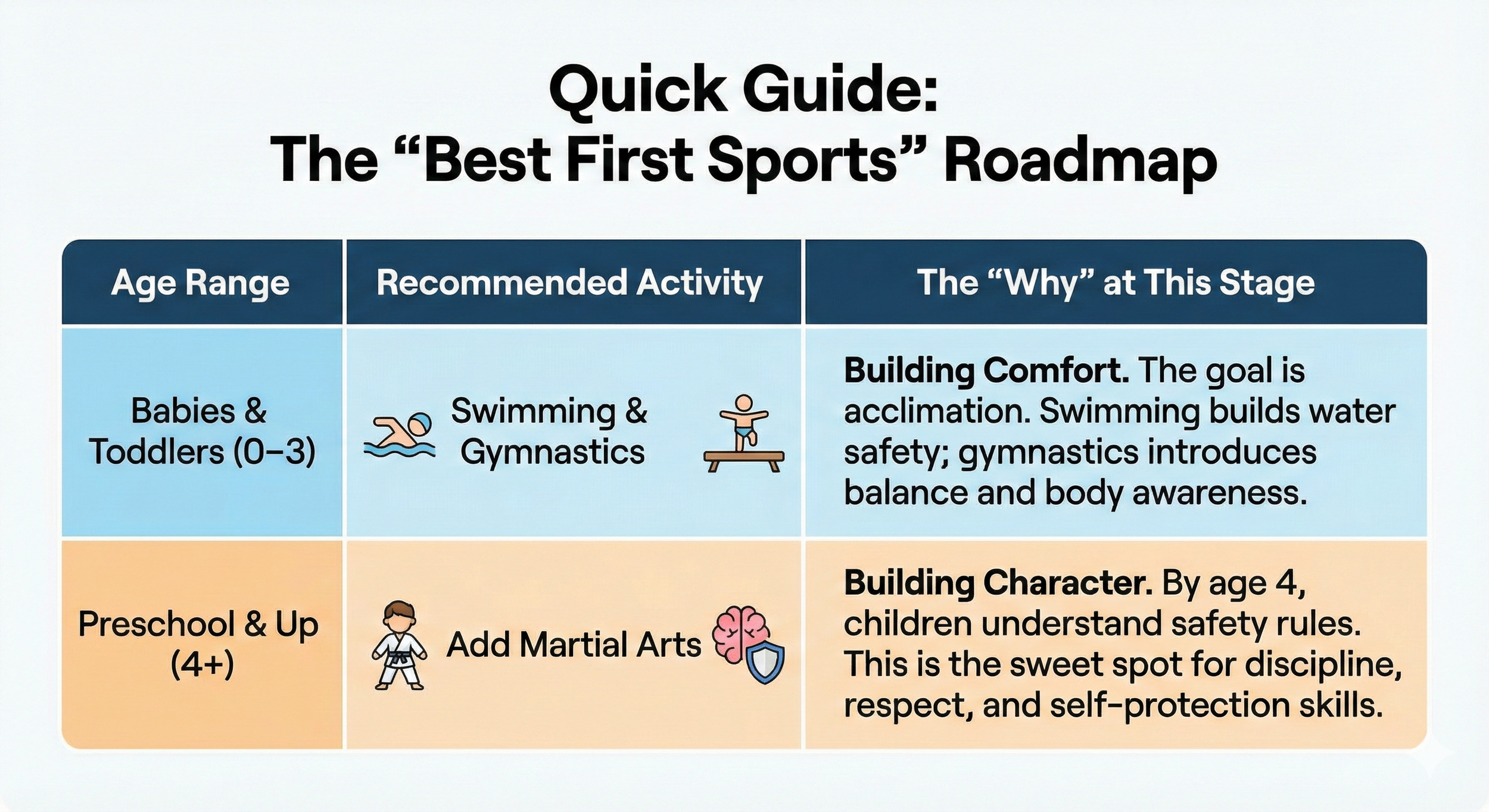
The Best First Sport for Kids
A Critical Note: The Importance of Variety
While we are championing these specific sports as the best foundation, there is a catch: Doing too much of one thing can be harmful.
To ensure your child is set up for long-term success, you must prioritize diversity of sport.
Avoiding the "Overuse" Trap
If a child specializes in a single sport too early, they repeat the exact same movements thousands of times. This leads to "overuse injuries"—stress fractures and tendonitis—because the same muscles are constantly hammered while others are neglected.
The Fix: Rotate sports (e.g., Gymnastics in winter, Swimming in summer) to ensure a balanced body where different muscle groups take turns working and resting.
Preventing Burnout
Mental fatigue is just as real as physical fatigue. Kids who grind in one sport year-round often quit by their teenage years because it feels like a job.
The Fix: Variety keeps it fun (remember Question #3!). The discipline of martial arts balances the freedom of swimming. The structure of gymnastics balances the team dynamic of soccer later on. Keep them interested by keeping it playful.
The Verdict
If you are looking for the highest return on investment for your child's time, follow this formula:
Start with Splash and Tumble: Use the toddler years (0-3) to build water safety and coordination through swimming and gymnastics.
Transition to the Dojo: Once they hit age 4, introduce Martial Arts to refine that coordination into discipline and self-protection.
Filter for Fun: Continuously ask if they are enjoying it. If the joy fades, don't be afraid to pivot.
Mix it Up: As they grow, ensure they aren't just doing one thing. Rotate their activities to protect their bodies and keep their minds fresh.
These aren't just sports; they are investments in the adult your child will become.
